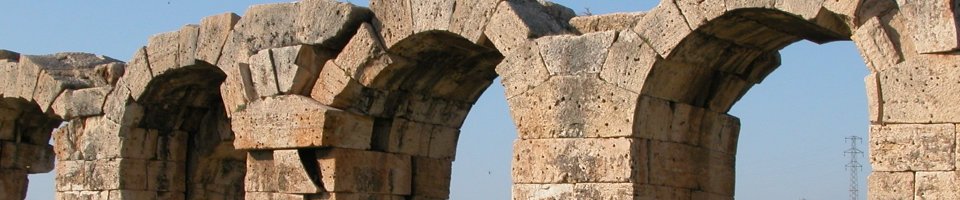
In the Hellenistic era, Laodikeia was the name given to a number of cities, founded by the successors of Alexander the Great. Our site is marked by the river Lykos (Çürüksu), and thus was called Laodikeia ad Lycum (Roman name, following earlier Hellenistic practice). Laodikeia ad Lycum is 6 km north-east of Denizli, and modern villages incorporated within the Hellenistic city’s borders are Eskihisar, Goncali, and Bozburun villages. Once founded by the Seleucid King Antiochos II sometime before 253 B.C., and named for his wife Laodike, the new city soon became the largest and most important city in the Lycos Valley. Pliny states that the Antiochian city of Laodikeia was formerly called Diospolis, “the city of Zeus,” and then Rhoas (Pliny, Natural History, V, 105).


he favorable geography of the site is augmented by the fertility of the Lycos Valley, its favorable climate, as well as being the crossroads of routes from central (Afyon, Konya) and southern Anatolia (Antalya, Burdur, Isparta, Fethiye), connecting with roads to the west. Archaeology shows that the site was occupied as early as Chalcolithic Era in prehistory (c. 5500 B.C.), and the roads of Greek, Hellenistic, and Roman times probably followed the tracks of earlier prehistoric trading paths. The small but fertile Lycos Plain is named after the Lycos River (Çürüksu), which rises from the skirts of the Honaz (Kadmos) mountain, crosses the central Lycos Plain and empties into the Meander River (Büyük Menderes) near Saraykoy. The plain is surrounded on the south by the Babadag (Salbakos) mountain range, on the west and north by the Buldan and Cokelez mountains, and on the east by the Honaz (Kadmos) Mountain. Strabo (XII 8.16) states that the Lycos River flows underground in several places, and he attributes the frequency of earthquakes in the region to these underground cavities.

The oldest settlements at the Lycos Valley are the Beylerbeyi Hoyuk hill near Saraykoy, Kumkisik Hoyuk and Kolossai Hoyuk. The Classical and Hellenistic settlements to the south of Laodikeia are the ancient cities of Attouda (Saraykoy-Hisarkoy), Trapezopolis (Babadag-Bekirler village), to the southwest is Karura (Saraykoy-Tekkekoy), on the west bank of the Menander river Tripolis (Yenicekent), to the north Hierapolis (Pamukkale), and to the east Kolossai.
Pliny’s listing of former name of Laodikeia includes Diospolis, “the city of Zeus,” suggesting the presence of a very old sacred precinct. This ancient tradition became reinvented in the religious observance of Zeus as the deity who founded Laodikeia, and the worship of Zeus continued throughout the pre-Christian centuries. Laodikeia continued as a religious center in Roman imperial times as seen in inscriptions celebrating the cult of emperors as gods.

iterary sources contain some data on Laodikeia, but they are uneven and sporadic. The next notice of Laodikeia comes in the confused account of Polybius (IV, 48.5, and V, 57. 5), wherein is related the jumbled history of succession problems, following the murder of Seleucos III in 223 B.C. A war had broken out between Seleucos III and Attalos I of Pergamon, and Seleucos had assigned his general Achaios to the campaign in northwestern Asia Minor against Attalos, while the king brought up a second army; urged to proclaim himself king (basileus), Achaios declined and supported Antiochus III after the assassination of Seleucos III. Achaios was successful against Attalos, and the soldiers renewed their demand that he proclaim himself king, which he did in 222 or 221 B.C. at Laodikeia. Other revolts in Syria against Antiochus III after 222 B.C. kept Antiochus’ attention away from the usurper, but in 213 B.C. Achaios was captured, mutilated, and impailed at the orders of Antiochos III, the same punishment that the Persian kings had meted out to traitors (fundamental is F. W. Balbank, Commentary on Polybius, Vol. I [Oxford, 1957], esp. pp. 500-502, 570-573, and Commentary, Vol. II [Oxford, 1967], pp. 6 and 92-98 [Polybius, VIII, 15-21). Lycos (Çürüksu) Valley remained under Seleucid rule until 190 B.C. when the Battle of Magnesia was fought between the Seleucids and the Pergamene Kingdom. After the Treaty of Apameia (Dinar) (188 B.C.), the Seleukids ceded control of Asia Minor to Pergamon, the current ally of Rome. Attalos III of Pergamon was childless, and at his death in 133 B.C., Pergamon was willed to the Roman Republic.
 Laodikeia struck common coinage and used it in common with Nikomedia (Iznik), Hierapolis (Pamukkale), Smyrna (Izmir), Ephesus (Selcuk), Pergamon (Bergama), Kolossai (Honaz) and Tripolis (Yenicekent). The oldest coins at Laodikeia are cistophoroi dating from the 2nd century B.C. (189-133 B.C.). On these are depicted wolf, lyre, head of the city goddess (Aphrodite or Laodike). On the semi-autonomous bronze coins that also began to be struck at the same time appear the writing LAODIKEWN (LAODIKEA) and figures such as goddess with tower crown, lion, head of Zeus, Apollo, Aphrodite, and Laodike. Funerary inscriptions from Laodikeia dating from the 3rd century B.C. indicate the presence of many important buildings such as a market, strategeion, gymnasium, and theatre are mentioned.
The most famous member of the ‘Polemo dynasty’ was the rhetorician Marcus Antonius Polemo (A.D. 88-144), whose dual residencies in Laodikeia and Smyrna kept him embroiled in the politics and intellectual life of both cities. His lineage was of the noblest; his abilities in speech-making excited the wonder and admiration of the Roman imperial literature known as the Second Sophistic. In The Lives of the Sophists by Lucius Flavius Philostratus (A.D. 180-c. 250) Polemo’s rage at the intrusion of Antoninus Pius (then governor of Roman Asia), who took over Polemo’s luxurious house in Smyrna (Izmir) is told: Polemo ordered the future emperor to leave—at midnight (Philostratus, Lives, 25. 534). After Antoninus Pius became emperor, he invited Polemos to Rome. The Emperor as if to remind the past event to Polemos told those with him: “Find Polemos a place he can’t be thrown out of.” The sophist spent huge sums for ostentatious display, and often was seen riding in a chariot with silver bridles. In rhetoric, Polemo’s learning attracted the friendship of emperor Trajan (A.D. 98-117), who granted the sophist the privelege of free travel wherever he wished, and Hadrian (ruled A.D. 117-138) extended the priveleges to Polemo’s posterity. An Arabic text shows that Polemo travelled with Hadrian in A.D. 123 in Thrace, Lydia, Phrygia, Rhodes, and Athens, along with Aegean islands (Georg Hoffmann, ed. [Arabic] and trans. [Latin], Polemonis De physiognonia in R. Foerster, ed., Scriptores physiognomici Graeci et Latini [Leipzig, 1893; rptd. Stuttgart, 1994; 2 vols.] vol. I, pp. 95-294).
Laodikeia had many other claims to fame in antiquity, and the city became one of the most important and flourishing commercial centers of Asia Minor, where an extensive trade and manufacture of wool brought it great wealth (Cicero, Letters to his Friends, II, 17. 4, and III, 5. 4; Strabo, Geography, XII, 8. 16). Laodikeia, Kolossai and Hierapolis achieved great fame in textile production in antiquity; the cities having formed a union took their textile products to Ephesus (Selcuk) harbour, whence they were exported to Samos (Sisam island), Athens and Italy. The most beautiful textile products of antiquity were woven in the Lykos (Çürüksu) Valley and they surpassed even those of Miletos (Balat). In the ancient period the Carian and Lydian cities were rivals of Laodikeia, Kolossai and Hierapolis in textile industry. In the region the washing, dying and the weaving of wool became an important sector. The greatest source of wealth of the city was a kind of raven colored sheep raised in Laodikeia and the woven products made from their wool. Strabo (XII 8.16) states that in Laodikeia a type of raven colored sheep with very soft wool was superior to even those raised at Miletos (Balat), and that due to this Laodikeians earned great income. Strabo describes this “Colossian” wool as raven-black in color, even as Pliny the Elder explains that it is wool dyed purple or madder-red from the dye gained from the root of the madder flower, Rubia tinctoria L. (Pliny, Natural History, XXI, 9. 27, and XXV, 9. 67). Vitruvius, Architecture, VIII, 3. 14, notes that the sheep of Laodikeia get their raven-black color from the foul-smelling waters they drink, which produced the very soft, jet-black wool. The wealth of its inhabitants, gained from the wool trade, or from commerce at the ancient crossroads, was legendary in antiquity, and literary sources reflect the glories of architecture, in turn mirrored in the remnants of the city seen today.The tunics woven in Laodikeia was so famous that in the Chalcedon Consul lists of the 4th and 5th c. A.D. the city was named Trimitaria. The prosperity of the city was tied to dressmaking and clothing trade. In Laodikeia not only the textile production, but also the clothing sector that developed in relation to it was rightfully famous. Laodiekia became very famous in antiquity because of the status she achieved in commerce. The mention of “Laodikeian” garments in the Edict shows that the textile sector was still of importance in the Late Roman period. Today the enterprising nature of the region’s people and the importance of Denizli’s textile industry mirror a 2300 years old tradition.

In the late Roman Republic and the first centuries of the Empire, Laodikeia was a major, if not the chief, city of the conventus of Kibyra (Golhisar) (Cicero, Letters to his Friends, III, 7; IX, 25; XIII, 54 and 57; Letters to Atticus, V, 15, 16, 20, and 21; VI, 1, 2, 3, and 7; Against Verres, I, 30). Roman governance probably reflected Laodikeia’s Hellenistic status as a major metropolis, equipped with a fully developed civic organization, a public gymnasion, and a tradition of honoring judges from neighboring cities. Cicero, while proconsul of Cilicia (51-50 B.C.), stayed at Laodikeia ten weeks hearing cases about infamous publicani “tax collectors” and administering justice.
The “gathering-together of people” (= conventus) were held at fixed urban centers where the provincial governor held court. The center of a conventus brought a city status and privilege. During the reign of Emperor Tiberius (A.D. 14-27) Laodikeia was the most beautiful and prosperous city in Phrygia. In the large earthquake in A.D. 60 all the cities in the Lycos (Çürüksu) Valley were devastated. While Hierapolis and other cities were restored with help from the Roman Empire, Laodikeia was able to rebuild by herself [Tacitus, Annals, XIV, 27]).

The presence of numerous Jewish communities—and their synagogues provided ready access to the early preachings of Christianity and St. Paul. The letters of Saint Paul sent to his Saint Epaphras of Colossai (Honaz) were read by Epaphras to the people of Laodikeia, Kolossai and Hierapolis. Although the Laodikeians were initially indifferent to this new religion because of their prosperity attained through textile and commerce, Christianity later spread rapidly in the valley. St. Paul’s Letter to the Colossians, I, 2 and IV, 15-16, indicates Laodikeia was the seat of an early bishopric, even though Revelation, III, 14, chastises the Church at Laodikeia for being merely “lukewarm” (neither hot nor cold). Revelation shows Laodikeia was one of the favored Seven Churches, a biblical reference well supported by numerous inscriptions, many of which were admirably collected and detailed by W. M. Ramsay, The Cities and Bishoprics of Phrygia (Oxford, 1895-1897; 2 vols), and The Social Basis of Roman Power in Asia Minor(Aberdeen, 1941), continually supplemented by crucial studies by L. Robert, “Les inscriptions,” in Laodicee du Lycos. Le Nymphee. Campagnes 1961-1963, ed. By J. des Gagniers, et al. (Paris, 1969), and many other scholars and archaeologists.

That Laodikeia remained an important city in Roman and Byzantine times is indicated by Diocletian’s proclamation (after A.D. 290) making the community metropolis of Phrygia; and the famous Price Edict of Diocletian (A.D. 301) gives prominence to the Laodikeian wool and clothing (heavy cloaks, mantles or chlamydes, fine outer cloaks or chlanides, heavy cloaks to repels rain [the paenulae], cloaks in one piece with clasps or fibulatoraia, plain underwear with a triple weave [two fine and one thick thread, trimita], and plain tunics [paragaudes] to which were added purple borders [Siegfried Lauffer, ed. Diokletians Preisedikt (Berlin, 1971), s.v. index entries ‘Laodicenus’]). In the Roman period, there are guilds of Laodikeia of fullers, dyers, and manufacturers of the one-piece garments cited among the tariffs in the Edict. TheEdict is secular evidence explaining the rebuking comments of the writer of Revelation, III, 15: “For you say, I am rich, I have prospered and I need nothing; not knowing that you are wretched, pitiful, poor, blind, and naked. Therefore I counsel you to buy from me gold refined by fire, that you may be rich, and white garments to clothe you and keep the shame of your nakedness from being seen, and salve to anoint your eyes, that you can see.” The Laodikeians are counseled to wear white garments since no fancy wool, dyed or otherwise, is permitted to the true Christian, and wealthy communities frequently corrupted the Christian, a condemnation voiced by Christian officials from the first century to the present day.
Christian controversies replaced the disputes of paganism, especially after the death of Constantine I (A.D. 337), who was the first emperor to convert to the not-so-new faith. A Council of Laodikeia (? After A.D. 345) set forth definitions of heretics, and the so-called Canons of Laodikeia (59 canons of c. A.D.350), probably are later additions to later Canon Law, and the Council itself may be apocryphal, although specialists in Church history remain uncertain of this text and its attributions (H. R. Percival, trans., The Seven Ecumenical Councils of the Undivided Church [Oxford 1900], pp. 123-160).
The city, which prospered greatly towards the end of the 2nd century A.D. built a temple in the name of Emperor Commodius (A.D. 180-192), and therefore received the title ‘Neokoros’ ‘guardian’s temple’ and was exempted from tax. The temple guardianship title was kept during the time of Emperor Caracalla (A.D. 211-217) as well. Among the Roman emperors Laodikeia welcomed in Hadrian in A.D. 129, Caracalla in A.D. 215 and Valens in A.D. 370. From the 3rdcentury on Laodikeia was the capital of Phrygia Pacatia.
In the Byzantine Period in A.D. 395 the city was surrounded by a fortification wall, which left some parts of the Hellenistic and Roman settlements outside the wall. The Byzantine city walls to the south left out the stadium, where the Bath-Gymnasium complex was considered as the boundary. To the east, the Syrian Gate and Bath building remained outside the city wall; the line of the walls in this direction comes straight over the Syrian Street (Colonnaded Main Street), where the Byzantine Gate, with rectangular towers on either side was built. To the north the city walls passed through the axis of the North (Great) and West (Small) Theatres. To the west the line of the wall passed over the Ephesus Gate in a suitable line for the rough terrain.
Laodikeia was completely levelled in the devastating earthquake in A.D. 494 after which it never quite recovered. The site continued to be the inhabited, and Byzantine writers occasionally mention Laodikeia. Laodicea was moved to Denizli-Kaleiçi with name of Ladik in the 7th century A.D. Where the site continued to be the inhabited and Byzantine writers occasionally mention Laodikeia. The reign of Manuel Comnenus (1143-1180) witnessed the fortification of the small community (in about 1160), and Niketas Choniates, Annals, IV, 179-180, notes that Laodikeia “…was not as thickly populated as now [c. 1180], nor was it fortified by secure walls, but spilled out to the villages along the slopes of the mountains” (trans. Harry J. Magoulias, O City of Byzantium: Annals of Niketas Choniates [Detroit], pp. 70-71. Kilic Arslan had besieged and sacked Laodikeia (Annals, XX), and the Turks inflicted a heavy defeat of a Byzantine army outside Myriokephalon in 1176, and Niketas Choniates notes that Manuel and his army passed through Laodikeia on his way to Myriokephalon. Passing under Turkish control, the city disappears from history.


 Antipater of Sidon, who compiled the list of the Seven Wonders, describes the finished temple:
 House of the Virgin Mary "Mother Mary's House") is a Christian and Muslim shrine located on Mt. Koressos (Turkish: Bülbüldağı, "Mount Nightingale") in the vicinity of Ephesus, 7 kilometres (4.3 mi) from Selçuk in Turkey